

In a world where technology is the heart of operations, making sure systems and applications are always available is essential. In that context, have you heard of a NOC (Network Operations Center)?
A NOC is a dedicated function for continuous monitoring of IT infrastructure. Whether the goal is to prevent failures in business-critical applications or to respond quickly to incidents, a well-structured NOC can be the difference between success and operational chaos.
In this article, we'll look at what a NOC is, why it matters and how it works. You'll also see why your technology company should consider it a priority.
What is a NOC?
NOC stands for Network Operations Center.
In IT, a NOC is a centralized team or facility responsible for monitoring, managing and maintaining the health of networks, servers, applications and other technology components.
Think of it as the “eyes” of your infrastructure, operating 24 hours a day, 7 days a week, to make sure everything works as expected.
It is especially important for companies that depend on applications, such as e-commerce or SaaS platforms, where any outage can be costly.
Read also:
What is it used for?
A NOC is used to oversee infrastructure in real time, identify problems before they escalate and ensure service continuity.
It serves as the first line of defense against failures such as server outages, slow applications or network disruptions.
For example, technology companies running high-traffic applications use a NOC to keep the user experience intact, avoiding lost revenue or billing losses.
In addition, the NOC collects data that helps analyze indicators such as response time and uptime, which are key to strategic decisions.
Example: imagine a streaming app like Netflix or Spotify. If a server fails or network latency increases, the NOC is the first to detect the problem, trigger automated remediation or escalate to the engineering team, so that users don't notice any disruption.
How does a NOC work?
A NOC rests on three pillars: tools, processes and people.
It operates 24 hours a day, 7 days a week, using monitoring software to track metrics such as network performance, CPU usage and application latency. Automated alerts are configured to fire when something deviates from the baseline.
The NOC runs on an analyze-and-act loop. Here's how it works in practice:
1. Data collection
Observability tools (such as Grafana or Prometheus) capture metrics in real time:
- Server availability;
- Network latency;
- CPU, memory and disk usage;
- Application traffic.
2. Analysis and alerting
AI systems and preconfigured rules identify anomalies:
- When configured, if an API's latency exceeds 200ms, for example, an alert fires;
- If a server hits 90% CPU usage, the NOC can automatically scale up resources.
3. Incident resolution
The NOC team can act in three ways:
- Automation: scripts restart services or rebalance load;
- Human intervention: engineers investigate root causes;
- Escalation: complex problems are routed to specialists.
Example flow
- An e-commerce application starts responding slowly;
- The NOC detects an unusual spike in requests;
- A load balancer kicks in to distribute the traffic;
- The team is alerted to investigate a possible attack or bug.
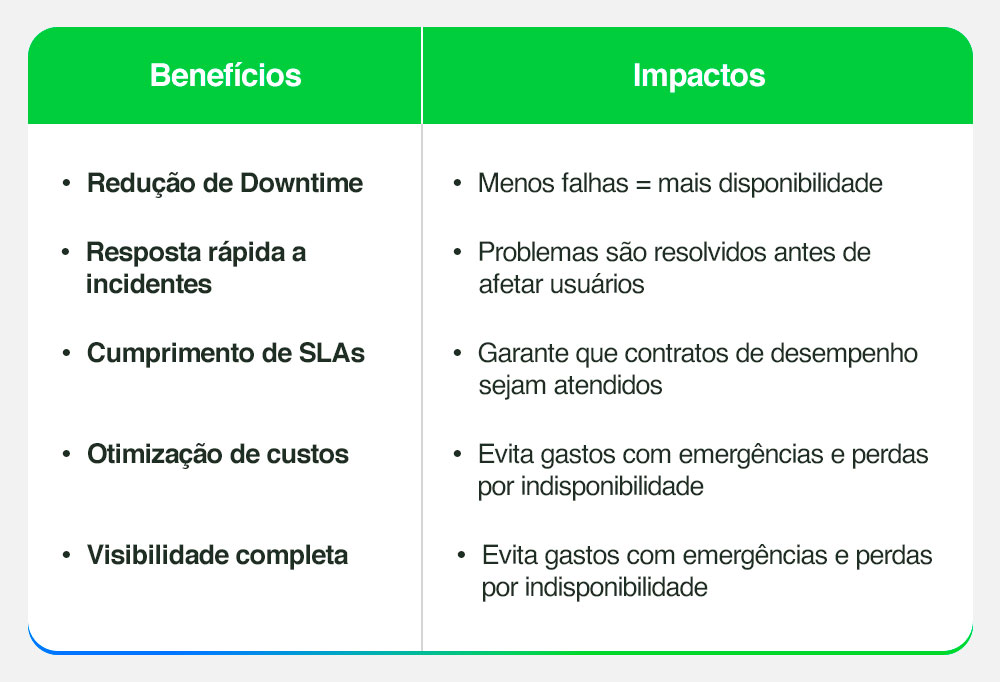
Benefits of implementing a NOC
NOC resources
A high-performance NOC relies on specific resources:
- Monitoring tools: software such as Grafana or Prometheus tracks metrics in real time;
- Automation: scripts and alerts designed to reduce manual intervention;
- Dashboards: panels with NOC indicators, such as uptime and latency, support decision-making;
- Trained team: skilled analysts who can interpret data and act fast;
- Documentation: runbooks detail the procedures for common incidents.
Together, these elements turn the NOC into a precision machine, essential for companies that can't afford to stop.
NOC vs. SOC
It's common to confuse a NOC with a SOC (Security Operations Center), but they serve different purposes.
The NOC focuses on infrastructure performance and availability — for example, making sure an application runs without slowdowns. The SOC, on the other hand, is focused on cybersecurity, monitoring threats such as DDoS attacks or data leaks.
Practical differences:
- Goal: the NOC pursues uptime and efficiency, while the SOC pursues protection against cyberattacks;
- Tools: the NOC uses solutions such as Nagios, while the SOC relies on SIEMs (e.g., Splunk);
- Combined use: many companies integrate their NOC and SOC. An e-commerce application, for example, can use the NOC to monitor traffic and the SOC to block fraud attempts. Together, they ensure a stable and secure environment.
| NOC (Network Operations Center) | SOC (Security Operations Center) |
| Focus on availability and performance | Focus on security and protection |
| Monitors networks, servers and applications | Detects intrusions, malware and leaks |
| Goal: minimize downtime | Goal: prevent cyberattacks |
| Example: fix API failures | Example: block hacking attempts |
Steps to implement a NOC
Whether you want to build a NOC from scratch or improve an existing one, follow these steps:
Define objectives and SLAs
- Establish which services are critical (e.g., APIs, databases, CDN);
- Set acceptable thresholds (e.g., latency < 200ms, uptime > 99.9%).
Choose the right tools
- Monitoring: Prometheus (metrics), ELK Stack (logs), Grafana (visualization);
- Automation: Ansible or Terraform for fast incident response;
- Integration: APIs to connect systems (e.g., alerts in Slack).
Build the team
- 24/7 shifts: Split coverage into shifts (morning, afternoon, night).
- Required profiles: Network engineers, cloud specialists and data analysts.
Create response playbooks
- Document procedures for common scenarios.
Run continuous testing
- Simulate failures (chaos engineering) to validate the NOC's effectiveness.
How to scale a NOC for large operations
Adopting AI and machine learning can transform your operation, using smart algorithms to predict failures before they happen — for instance, detecting latency patterns in APIs or abnormal resource consumption that may signal imminent problems. This proactive approach dramatically reduces downtime.
Another essential step is to centralize multi-cloud operations, bringing AWS, Azure and GCP monitoring into a single, unified pane of glass. This global view eliminates information silos and enables faster, more accurate decisions about your distributed infrastructure.
For many companies, outsourcing parts of the operation makes a lot of sense, especially through partnerships with MSPs (Managed Service Providers).
They can cover night shifts, provide security specialists or offer on-demand technical support, letting your internal team focus on strategic work.
Finally, don't neglect success metrics. Religiously track KPIs such as MTTR (Mean Time to Repair), the average time to resolve incidents, and keep working to reduce the number of false alerts by fine-tuning your monitoring thresholds.
These indicators are the thermometer of your NOC's health and guide your continuous improvement decisions.
High-performance NOC: Elven
Building a high-performance NOC is more than a technical choice — it's a strategy for keeping applications and services up, 24 hours a day, 7 days a week.
With the right tools, well-defined processes and a prepared team, the NOC not only prevents problems but also provides valuable data for the future of your operation.
Need to set up 24/7 monitoring for your operation? Count on Elven: the Brazilian Observability & AIOps platform, with Command Center and incident management in one place. Get in touch with our team.
