
When a service goes down, every minute counts. And yet most teams can't say how long it takes between an alert firing and someone actually starting to act on it. That's where two fundamental incident response metrics come in: MTTA and MTTR.
In this article, you'll learn what each one measures, why they matter to your business and — most importantly — what to do in practice to reduce them.
What MTTA and MTTR are
They are two indicators that measure how fast your operation reacts to a failure:
- MTTA (Mean Time To Acknowledge) — the average time between an alert firing and someone acknowledging that they will act on it. It measures how responsive your detection and on-call process are.
- MTTR (Mean Time To Resolve) — the average time between the start of an incident and its full resolution. It measures the efficiency of the entire response.
In one sentence
MTTA shows how fast you notice the problem. MTTR shows how fast you fix it. Reducing one without the other leaves money on the table.
Why these metrics matter to the business
Downtime has a direct cost: lost revenue, breached SLAs, a dented reputation and exhausted teams. A high MTTA means alerts sit idle with nobody acting on them. A high MTTR means that, even once people act, the team takes too long to restore service.
Tracking these numbers turns your operation from reactive into data-driven — you stop "feeling" that things got better and start proving it.
5 practical ways to reduce your MTTA
1. Eliminate alert fatigue
If everything is critical, nothing is critical. Tune thresholds, group correlated alerts and silence the noise. On-call engineers need to trust that when their phone goes off, it's real.
2. Route the alert to the right person
Smart routing rules make sure the alert goes straight to whoever has the context — without passing through a generic queue nobody watches.
3. Have a clear on-call schedule
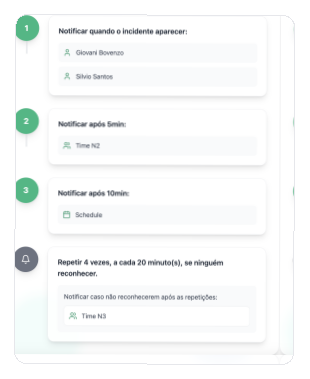
Everyone needs to know who is on call right now. Automatic rotations and escalation policies (if A doesn't respond within X minutes, page B) cut MTTA dramatically.
How to tackle MTTR
Reducing time to resolution is less about "rushing" and more about reducing uncertainty. A few pillars:
- Context in the alert — the more the alert already carries (affected service, dashboards, runbook), the less time the team spends investigating.
- Actionable runbooks — documented procedures for the most common incidents keep you from reinventing the wheel at 3 a.m.
- Centralized collaboration — a single war room with an incident timeline keeps information from getting lost across channels.
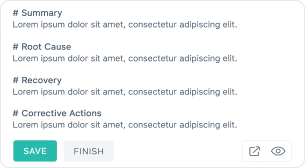
- Blameless postmortems — every incident becomes a lesson that prevents the next one, pushing MTTR down over time.
You can't improve what you don't measure. Start by recording MTTA and MTTR for every incident — the simple act of measuring already changes how the team behaves.
Putting it into practice with Elven
The Elven platform brings alerts, on-call schedules, smart routing and postmortems together in one place — with MTTA and MTTR calculated automatically for each service. That way, you not only reduce response times but also prove the improvement with data.
Want to see it in action? Discover Elven's Incident Manager and start a free trial.